The Red Sea wildlife is one of the main reasons travelers choose Egypt for a seaside holiday. Beneath the clear blue water lies a remarkably diverse marine environment filled with colorful fish, coral communities, sea turtles, rays, dolphins, moray eels, crustaceans, mollusks and many other forms of marine life.
For visitors staying in Hurghada, exploring this underwater world can be as exciting as visiting ancient temples or walking through the desert. A simple snorkeling trip can reveal an entirely different side of Egypt. Instead of monuments made by humans, you discover a living landscape shaped by coral, currents, sunlight and thousands of marine organisms.
However, there is one important point every traveler should understand before booking a Red Sea wildlife excursion: wild animals are not attractions that operate on a schedule. A sea turtle may appear during one trip and remain hidden during another. Dolphins may pass near a boat, or they may be elsewhere. A particular fish may be easy to find in one location but difficult to spot on another day.
Therefore, responsible travel begins with realistic expectations. The goal should not be to force an encounter. It should be to enter the marine environment quietly, observe what nature offers and leave the ecosystem undisturbed.
This guide explores the animals and underwater communities you might encounter in the Red Sea, explains where they live, and offers practical advice for observing marine wildlife responsibly.
Why Is Red Sea Wildlife So Diverse?
The Red Sea is a long, relatively narrow sea between northeastern Africa and the Arabian Peninsula. Its warm waters, extensive coral reefs, rocky coastlines and different underwater habitats create favorable conditions for a wide range of marine species.
One of the most impressive features is the extensive coral reef environment.
Coral reefs are not simply underwater decorations. They are complex living ecosystems. Corals create structures that provide shelter and feeding areas for many other organisms. Small fish hide between branches and crevices, while larger predators search around the reef for food.
The result is an underwater community in which different species are connected.
A reef can contain:
- hard corals,
- soft corals,
- reef fish,
- sea turtles,
- moray eels,
- rays,
- crustaceans,
- mollusks,
- sea stars,
- sea cucumbers,
- sponges,
- anemones and many microscopic organisms.
This diversity means that snorkeling in the Red Sea is rarely about seeing one specific animal. It is about discovering an entire ecosystem.
Coral Communities: The Foundation of the Underwater Landscape
When people imagine Red Sea marine life, they often picture brightly colored fish. Yet the coral community deserves equal attention.
Corals are animals, not plants. Individual coral polyps are tiny organisms that live together in colonies and can build large reef structures over long periods.
These structures create the physical architecture of the reef.
A coral formation can provide:
- hiding places for small fish,
- surfaces where organisms can feed,
- shelter from currents,
- nursery areas for young marine animals,
- hunting grounds for predators,
- habitats for invertebrates.
The appearance of a reef can change dramatically from one location to another.
Some areas have large branching formations. Others feature rounded coral heads, rocky surfaces covered with coral growth or colorful soft corals moving with the current.
For snorkelers, this means that even when larger animals are not visible, there is still plenty to observe.
Look closely rather than simply swimming quickly over the reef. Small creatures can be hiding in places that are easy to miss.
Colorful Reef Fish
Fish are among the easiest forms of Red Sea wildlife to observe during snorkeling.
Many reef species remain relatively close to coral formations because the reef provides food and protection.
Parrotfish
Parrotfish are particularly interesting because of their unusual body shapes, bright colors and strong beak-like teeth.
They use their teeth to scrape algae and other material from surfaces. Their feeding behavior plays an important role in reef ecosystems.
Some species can appear in shades of blue, green, turquoise, yellow or combinations of several colors.
Because they often feed around reefs, snorkelers may encounter them swimming over coral structures or rocky surfaces.
Surgeonfish
Surgeonfish are another familiar group in the Red Sea.
They are often recognized by their laterally compressed bodies and distinctive markings. Some species travel alone, while others can be seen in groups.
Their movements can be fascinating because a school of fish may suddenly change direction almost simultaneously.
Butterflyfish
Butterflyfish are known for their attractive patterns and laterally compressed bodies.
They often stay close to reef structures and can sometimes be seen moving in pairs.
Their bright markings make them popular subjects for underwater photography.
Angelfish
Angelfish add another layer of color to the reef environment.
Depending on the species, they may display strong contrasts of blue, yellow, white or other colors.
They often move carefully around coral structures, which means patient snorkelers may have better opportunities to observe them.
Wrasses
Wrasses represent another diverse group found around Red Sea reefs.
Some are small and subtle, while others are larger and extremely colorful. Their behavior varies considerably between species.
This is a good reminder that the Red Sea is not defined by a handful of famous animals. It contains an enormous variety of smaller species that are equally important to the ecosystem.
Sea Turtles in the Red Sea
Seeing a sea turtle in the Red Sea can be one of the most memorable moments of a snorkeling trip.
Several turtle species are associated with Red Sea waters, with green turtles and hawksbill turtles among the species visitors may encounter.
Sea turtles use marine habitats for feeding, resting and traveling.
A turtle might appear:
- near a coral reef,
- over a seagrass area,
- close to a sheltered bay,
- near rocky coastal habitats,
- or in open water while traveling between locations.
But seeing one is never guaranteed.
A turtle may be underwater for an extended period, resting in a location that snorkelers cannot see or simply moving through another part of the area.
How Should You Behave Around a Sea Turtle?
If you see a turtle, the best response is usually to slow down.
Do not chase it.
Do not swim directly toward it.
Do not attempt to touch its shell.
Instead, maintain a respectful distance and allow the turtle to continue its natural behavior.
If the animal changes direction because of your presence, that is a useful signal that you are too close.
The best wildlife encounter is one in which the animal behaves naturally and appears largely unaffected by the people observing it.
Dolphins: A Special but Unpredictable Encounter
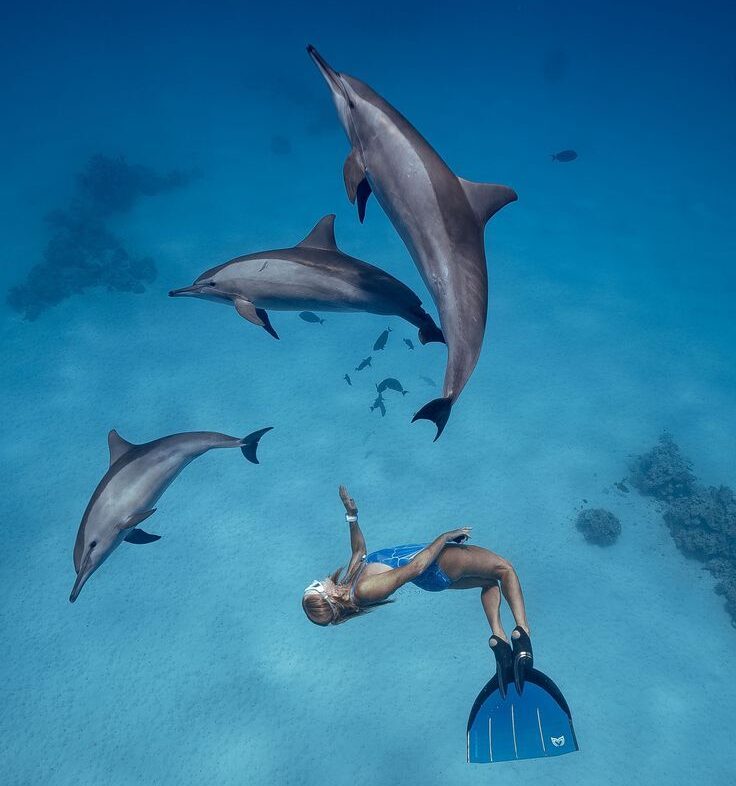
Dolphins are among the most exciting animals travelers hope to see during a Red Sea boat trip.
Different dolphin species occur in the region, and some areas are known for regular dolphin activity. However, this does not mean that every excursion will produce a dolphin encounter.
Dolphins are wild marine mammals.
They move according to food availability, social behavior, currents, weather and many other natural factors.
They can travel considerable distances, and their location can change quickly.
Therefore, responsible tour operators should never present dolphin sightings as an absolute guarantee.
If dolphins appear near a boat, travelers should avoid shouting, chasing or attempting to force interaction.
Watching from a respectful distance is much better than trying to turn a natural encounter into a performance.
Rays and Their Graceful Movements
Rays are another possible Red Sea wildlife encounter.
They can often be recognized by their flattened bodies and broad fins, although different ray species have very different shapes and behaviors.
Some rays spend considerable time close to the seabed. Others are more active swimmers.
When a ray moves through the water, its fins can create a graceful wave-like motion.
If you see one while snorkeling, avoid swimming directly above it at close range.
Give it space and allow it to move away naturally.
Rays are generally more interesting to watch when you observe their behavior rather than trying to get as close as possible.
Moray Eels: Hidden Residents of the Reef
Moray eels are among the most fascinating animals hiding within coral reefs.
Their long bodies and unusual appearance make them instantly recognizable.
They often spend much of their time inside holes, cracks and crevices.
A snorkeler may see only the head of a moray eel emerging from a shelter.
The animal’s mouth may appear to open and close repeatedly. This is part of its normal breathing behavior and should not automatically be interpreted as aggression.
The safest approach is simple: observe without touching.
Never put your hands into reef holes or crevices. You cannot know which animal is using the space as shelter.
Octopuses and Other Intelligent Reef Residents
Octopuses can be much harder to spot than colorful fish because camouflage is one of their greatest abilities.
An octopus may change its appearance to blend into rocks and surrounding surfaces.
This makes searching slowly and carefully worthwhile.
Instead of looking only for movement, look for unusual shapes, textures or colors.
Other small animals can also make snorkeling fascinating, including:
- crabs,
- shrimp,
- sea stars,
- sea cucumbers,
- nudibranchs,
- shells and mollusks,
- anemones,
- small reef invertebrates.
Some of these creatures are only a few centimeters long.
They may not attract attention immediately, but they demonstrate how much life exists within the reef.
Sea Anemones and Their Tiny Neighbors
Sea anemones are particularly interesting because they create relationships with other marine organisms.
Clownfish are famous for their association with anemones in some parts of the world’s tropical seas, although the exact species present varies by region.
The anemone provides protection through its stinging cells, while associated fish can benefit from the shelter.
For snorkelers, anemones are a good example of why underwater observation should be slow and patient.
A colorful fish may be only one small part of a much larger relationship happening around it.
Smaller Animals Matter Too
One of the biggest mistakes beginners make is focusing exclusively on large animals.
A successful snorkeling experience does not have to include a dolphin, turtle or ray.
A reef filled with small fish and invertebrates is already a remarkable wildlife experience.
Look for:
- tiny fish moving between coral branches,
- shrimp hiding near rocks,
- crabs under ledges,
- sea cucumbers on the seabed,
- small shells,
- colorful sponges,
- anemones,
- juvenile fish,
- small wrasses and gobies.
The more carefully you observe, the more you begin to understand that the reef is constantly active.
Why Wildlife Sightings Cannot Be Guaranteed
This point deserves special attention.
Travelers sometimes search for excursions described as offering guaranteed sightings of turtles, dolphins or other animals.
But wildlife cannot be guaranteed.
Even experienced guides cannot control:
- animal movement,
- water conditions,
- currents,
- visibility,
- feeding patterns,
- seasonal behavior,
- boat traffic,
- weather,
- natural changes in habitat.
A location may be famous for turtle sightings, but a turtle can still choose another area that day.
Dolphins may be commonly observed in a particular region, yet they can travel elsewhere.
A responsible excursion should therefore describe wildlife encounters as possibilities rather than promises.
When choosing a trip with Best Tours Hurghada, travelers should think of the excursion as an opportunity to explore the marine environment rather than purchasing a guaranteed animal encounter.
That mindset makes the experience more rewarding and more respectful toward wildlife.
Responsible Wildlife Observation in the Red Sea
Enjoying marine wildlife also means protecting it.
The Red Sea’s coral reefs are living environments that can be damaged by careless behavior.
Do Not Touch Coral
Even a seemingly harmless touch can damage delicate coral organisms.
Some coral structures are extremely fragile.
Keep your hands away from the reef and maintain enough distance to avoid accidental contact.
Do Not Stand on the Reef
Standing on coral can break or crush living structures.
If you need to rest while snorkeling, move to a suitable sandy area rather than placing your feet on coral.
Do Not Chase Animals
If a turtle, dolphin or ray moves away, let it go.
Swimming after wildlife can create stress and may disrupt natural behavior.
The objective is observation, not pursuit.
Never Feed Wild Animals
Feeding marine animals can change their natural behavior.
It may also encourage animals to approach humans or boats in inappropriate ways.
Wildlife should remain dependent on its natural environment.
Do Not Collect Marine Life
Do not take:
- coral fragments,
- shells containing living organisms,
- sea stars,
- other marine animals,
- or other natural objects from protected areas.
A photograph is a much better souvenir than removing something from the ecosystem.
Keep the Water Clean
Never throw plastic, food packaging or other waste into the sea.
Even small pieces of rubbish can become dangerous for marine animals.
Good Snorkeling Technique Protects the Reef
Responsible snorkeling is not only about what you do with your hands.
Your swimming technique matters too.
Try to remain horizontal in the water and maintain good control over your fins.
Avoid kicking close to coral structures.
If your fins repeatedly strike the reef, move farther away.
Beginners can improve their technique by practicing in open water before approaching shallow coral areas.
A guide can also help you understand where you should and should not swim.
Why a Guide Can Improve the Wildlife Experience
A knowledgeable guide can make snorkeling more educational.
Instead of simply pointing at a turtle or fish, a good guide can explain:
- what species you are seeing,
- how the animal behaves,
- what it eats,
- why it lives in that habitat,
- how the reef supports it,
- and how visitors can avoid disturbing it.
Guides can also help with safety and local environmental rules.
However, a guide cannot control nature.
The guide may know where certain species are commonly found, but that does not mean an animal will appear during every excursion.
Best Places to Explore Red Sea Wildlife from Hurghada
Hurghada is a popular base for marine excursions because it provides access to many coastal and offshore environments.
Depending on the excursion, travelers may visit:
- coral reef areas,
- offshore islands,
- sheltered bays,
- snorkeling sites,
- shallow coastal waters,
- deeper reef environments.
Different locations offer different experiences.
One site may be particularly interesting for colorful reef fish.
Another may provide better conditions for beginners.
Another may be known for opportunities to observe larger marine animals.
This variety is one reason Hurghada is so attractive to snorkeling enthusiasts.
What Is the Best Time to See Marine Wildlife?
There is no single hour that guarantees wildlife sightings.
Marine animals follow their own behavior patterns.
Visibility can also change depending on:
- wind,
- waves,
- currents,
- sunlight,
- water conditions,
- and seasonal factors.
Morning excursions are often attractive because the light can be pleasant and sea conditions may be favorable, but this does not mean that wildlife is guaranteed at a particular time.
The most useful approach is to select an excursion based on the overall quality of the experience rather than a promise of seeing one specific animal.
What Should You Bring on a Red Sea Wildlife Excursion?
A small amount of preparation can make a snorkeling day much more comfortable.
Consider bringing:
- swimwear,
- towel,
- hat,
- sunglasses,
- reef-conscious sun protection,
- drinking water,
- waterproof phone protection,
- comfortable footwear for appropriate boat or beach areas,
- a light cover-up,
- and any personal essentials recommended by the operator.
If you use a camera, make sure you can operate it without getting too close to animals.
A long-lasting photograph is better than a stressful encounter.
Wildlife Photography: How to Take Better Pictures Responsibly
Underwater photography can be challenging.
Water reduces contrast and changes the appearance of colors. Movement, waves and limited visibility can make focusing difficult.
The best wildlife photographs often come from patience.
Instead of chasing an animal, remain still and allow it to move naturally through the area.
Avoid blocking its path.
Do not touch coral to stabilize yourself.
Do not hold or manipulate an animal for a photograph.
A good wildlife photograph should document natural behavior rather than create a staged moment.
Families and Red Sea Wildlife
A snorkeling trip can be educational for children because it introduces them to marine biology in a direct and memorable way.
Children can learn that:
- coral is alive,
- fish depend on habitats,
- sea turtles need clean water,
- dolphins are wild animals,
- and humans have a responsibility to protect marine ecosystems.
Parents should choose activities suitable for their children’s swimming ability and follow the excursion operator’s safety instructions.
For young children or inexperienced swimmers, supervised snorkeling in appropriate shallow areas may be preferable.
Couples and Wildlife Excursions
For couples, a Red Sea wildlife excursion can offer something different from a traditional beach day.
Watching a sea turtle glide through clear water or observing a colorful reef together can become one of the highlights of a holiday.
The experience does not need to be dramatic.
Sometimes the most memorable moments are quiet ones: floating above a reef, watching fish move through coral formations and listening to the sound of the water.
How to Choose a Responsible Red Sea Wildlife Excursion
Before booking, consider more than the itinerary.
Ask:
- What snorkeling locations are included?
- How long will guests spend in the water?
- Is snorkeling equipment provided?
- Are guides present in the water?
- What safety measures are followed?
- What environmental rules apply?
- Does the operator discourage touching or feeding wildlife?
- Are wildlife sightings described as possible rather than guaranteed?
- How large is the group?
- What happens if weather or sea conditions change?
These questions can help you choose an experience that prioritizes both enjoyment and responsible tourism.
Red Sea Wildlife Is More Than a List of Animals
It is tempting to approach snorkeling with a checklist:
“Turtle — yes.”
“Dolphin — yes.”
“Ray — yes.”
“Moray eel — yes.”
But this approach misses the larger story.
The Red Sea is an ecosystem.
A coral reef is a community where hundreds or thousands of organisms interact.
A tiny fish hiding in coral is connected to the structure of the reef.
A turtle depends on healthy marine habitats.
A predator depends on prey.
Coral depends on environmental conditions.
Human tourism also becomes part of this system.
The choices visitors make can either reduce or increase pressure on marine environments.
That is why responsible wildlife tourism matters.
A Different Way to Experience Hurghada
Hurghada is often associated with beaches, hotels and sunshine.
But beneath the surface is another world.
A snorkeling excursion can transform the way travelers see the destination.
The sea becomes more than a place to swim.
It becomes a living environment.
The reef becomes more than colorful scenery.
It becomes a habitat.
A turtle becomes more than a photograph.
It becomes a wild animal that deserves space.
And a dolphin sighting becomes more meaningful because it happened naturally rather than because someone promised it.
This perspective makes marine excursions more educational and more respectful.
Red Sea Wildlife FAQ
What animals can I see while snorkeling in the Red Sea?
Depending on the location and conditions, you may encounter colorful reef fish, sea turtles, rays, moray eels, octopuses, crustaceans and many smaller reef organisms. Dolphins and other larger animals may also be encountered during some excursions.
Are dolphins guaranteed on Red Sea excursions?
No. Dolphins are wild animals, so sightings cannot be guaranteed. Their movements depend on natural conditions and behavior.
Can I touch a sea turtle?
No. Observe turtles from a respectful distance and never chase, touch or block their path.
Can I touch coral?
No. Coral is living marine habitat and can be damaged by physical contact.
Is snorkeling in Hurghada suitable for beginners?
Many excursions offer snorkeling opportunities for beginners, but suitability depends on the specific location, sea conditions, swimming ability and operator. Beginners should follow the guide’s instructions and use appropriate safety equipment.
What if I do not see any large animals?
Your trip can still be highly rewarding. Coral reefs contain enormous numbers of smaller organisms, and observing fish, corals and invertebrates can be fascinating.
Why are wildlife sightings unpredictable?
Marine animals move freely through large areas. Weather, currents, food availability, water visibility and natural behavior can all influence where animals are found.
How can tourists help protect the Red Sea?
Avoid touching coral, chasing wildlife or feeding animals. Keep your fins away from reefs, never leave rubbish behind and follow local environmental guidance.
Final Thoughts
The Red Sea wildlife is one of Egypt’s greatest natural treasures.
From brilliantly colored reef fish to sea turtles, rays, moray eels, octopuses and possible dolphin encounters, the underwater environment offers an extraordinary variety of life.
Yet the most important lesson is that wildlife should remain wild.
No responsible excursion can guarantee that a particular animal will appear. Nature does not follow a timetable, and every trip can be different.
That uncertainty is part of the magic.
A turtle appearing unexpectedly beside a reef can be more special precisely because nobody could guarantee it would happen. A school of fish suddenly crossing your path can create a memorable moment without any need to disturb them.
For travelers exploring Hurghada, companies such as Best Tours Hurghada can be part of a broader holiday experience that combines the Red Sea with beaches, islands, desert adventures and historical excursions.
The best marine adventure is not simply the one where you see the most animals.
It is the one where you discover something new, respect the environment and leave the sea as beautiful as you found it.
The Red Sea does not need to perform for visitors.
It only needs to be given the space to reveal itself.